
A Journey Through The Earthway Green Living Program
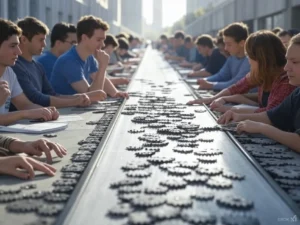
In this modern labyrinth where education often feels like a conveyor belt, churning out uniform cogs for society's machine, the art of fostering independent thought is as rare as a wildflower pushing through the cracks of a concrete jungle. My journey, from the rigid classrooms of my Catholic school days where conformity reigned supreme, to the vast, breathtaking landscapes of Alaska, and the profound teachings of the Lakota, has taught me that education should not just mold but also ignite the spirit of inquiry.

A Classroom of Conformity
Reflect on those school days, where the classroom was a battlefield of conformity. Rows of desks, the silent sea of students, all eyes fixed on the teacher, who stood at the front, more like a vending machine of facts than a guide for thinkers. Here, the curriculum wasn't a river to explore but a narrow path to follow, with little room for the meandering curiosity that defines true human learning. I recall the rigidity of this system, where my youthful questions were met with a frown instead of a welcoming smile, where the creativity of drawing with lipstick on a wall was met with harsh punishment rather than encouragement.
Today's educational system, this relic from the industrial revolution's assembly line model, was designed to produce workers who could follow orders, adhere to schedules, and perform repetitive tasks. Here's how it manifests:
- Standardized Curriculum: A one-size-fits-all approach where the curriculum spans vast regions, ensuring all students learn the same content, tailored more to pass standardized tests than to nurture individual talents or interests. In the U.S., the Common Core State Standards dictate what students should know, leaving little room for deviation, for teachers or students to wander off the beaten path.
- High-Stakes Testing: Tests like the SAT or ACT in America, or GCSEs in the UK, measure students' abilities in a narrow, often multiple-choice format, emphasizing memorization over creativity or critical thinking. The pressure to perform well on these exams can lead to "teaching to the test," where education becomes about passing rather than truly learning.
- Time Management: The school day is segmented into precise blocks by the bell, where subjects are taught in isolation. This fragmented approach can stifle the natural flow of learning that might occur if one's curiosity leads from one subject to another, like the wandering path of a river through a forest.
- Discipline Over Discovery: Strict discipline, often punitive, teaches students that obedience is the primary mode of interaction in education. This contrasts sharply with environments where exploration and questioning are celebrated, where learning is a dance with curiosity.
- One-Size-Fits-All Teaching: Teachers are expected to deliver content in a manner that suits the "average" student, ignoring the wide spectrum of learning styles and paces. This can lead to disengagement, especially for those who learn differently or at a different speed from the norm.
In this system, our education mirrors a factory, where students are the products, molded to fit into society's mold rather than to explore the unique contours of their minds and passions. It breeds conformity over innovation, compliance over curiosity, and performance over personal growth. The natural human desire to learn through questioning, exploring, and doing is often suppressed in favor of producing uniform outcomes.
The Spark of Curiosity

Yet, beneath this veneer of conformity, there lies an innate ember of curiosity within each of us, a spark that, if fanned, can light the path to self-directed learning. This spark is the very essence of what we at The Earthway Green Living Program strive to cultivate, awakening the natural inquisitiveness that connects us to the rhythms of the earth.
- Encourage Questioning: In the Lakota tradition, stories are not just narratives but lived experiences, invitations to ponder life's mysteries. In our program, we treat every "Why?" or "What if?" as a sacred question. Imagine us under the ancient oaks of Somartin, inviting each child to wonder about the life cycle of a leaf, to understand its journey from sprout to soil, teaching that the earth has endless stories if only we listen.
- Project-Based Learning: My journey into permaculture taught me that learning through doing is profoundly educational. We encourage projects where children can build habitats for local wildlife or design sustainable gardens. Here, they learn that nature isn't just a subject to be studied but a world to interact with, where each project is an adventure in ecological balance.
- Socratic Seminars: Inspired by the wisdom of Lakota council circles where every voice has value, we create spaces for discussion. Students debate the ethics of environmental stewardship or the philosophy of living in harmony with nature. Through these discussions, they learn to articulate their thoughts, challenge ideas, and respect diverse viewpoints, fostering a community of thinkers rather than followers.
- A Growth Mindset: Echoing Zen teachings, we celebrate the journey of self-improvement, emphasizing effort over outcome. Every failed gardening attempt or compost heap that doesn't work out becomes a lesson in resilience and growth, mirroring the life lessons of living in balance.
- Empowerment through Choice: Inspired by indigenous teachings where one conceives, believes, then achieves, we empower children by giving them choices. Whether choosing which fruit trees to plant or which animals to study, they learn that their choices shape their world, mirroring my own life's navigation towards personal freedom and responsibility.
- Exposure to Diverse Thinkers: We share stories of those who've walked before us, from Lakota holy men to modern permaculture visionaries. These stories are not just history but living proof that independent thought can lead to a life in harmony with nature. They remind us that life, like the spiral of a conch shell, refines our understanding with each turn.
Crafting a New Educational Paradigm

The Earthway Green Living Program, or any initiative following these principles, is not just about imparting knowledge; it's about teaching how to think, how to be in the world. We weave these practices into the daily fabric of learning, transforming each day into an exploration rather than a march down a predetermined path. Like the spiral of a conch shell, we start wide, exploring broadly, then with each turn, we refine our view, gaining deeper insights into our true selves and our relationship with the earth.
For parents at home or in homeschooling environments, this could mean creating a small garden where children learn by doing, where each plant isn't just a specimen but a friend with its own story. Nature walks become opportunities for questioning, where the world reveals itself in a spectrum of colors and textures, each with lessons to share. Here, in the quiet corners of our homes, we can teach our children, and ourselves, to listen to the earth, not just to hear but to truly understand its language.
In conclusion, let us not aim for the uniformity of thought but for the diversity of minds. Education should be like lighting a fire, stoking curiosity, encouraging exploration, and living in balance with the 54 senses Dr. Cohen speaks of, culminating in the sense of homeostatic unity. Through programs like The Earthway or in the simple acts of daily life, we can guide our young to think for themselves, to question, and to embody the spirit of an Earth Avatar, living in respect and harmony with our planet.
——————————————————————————————————————
In Harmony,
Kevin
Walk with me on The Earthway. Share your journey, your balance, your light, and your shadows. Together, let's explore how our diverse paths can lead us to a unified understanding of life.
Leave your thoughts, experiences, or questions in the comments below.