
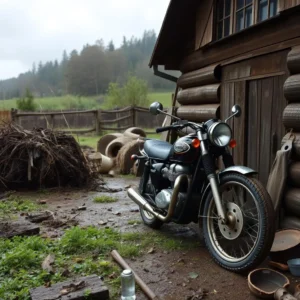
Setting: The Saxon yard in Somartin, Transylvania—mud rules the sprawl behind the barn, a rough scar of forgotten land, boots sinking into its cold grip. Rock-hard in summer, now a soggy stretch, it’s Corey’s to tease awake. Compost heaps steam faintly, straw bales slump against the shed, leaf piles rot into dark mounds—organic veins for a no-dig patch. The Triumph motorcycle, a battered ’60s relic, leans dull against the wood, its chrome glinting weak under a gray sky. Somartin’s 250 souls hum beyond the yard; Gherdeal’s 20 flicker 15 minutes west, a whisper of a village clinging to the valley.
Morning in the Muck
The Saxon yard in Somartin sprawls rough behind the barn, a muddy scar of forgotten land, cold and slick under a gray dawn. Corey kneels in it, small hoe in hand, flicking weeds free—dock roots thick as fingers, nettles with their sting still sharp, tough bastards baked into this patch for years. “No digging,” he mutters, breath fogging in the early spring chill, “let the earth breathe.” The mud clings to his knuckles, cold and heavy, but a faint warmth seeps through, a slow thaw stirring beneath his palms. He drags the hoe light across the surface, breaking a clod, and a whiff of wet grass rises—sharp, green, cutting through the damp air.
Iris trails him, hauling a straw bale, its edges fraying as she hefts it over her shoulder. Her boots squelch with each step, sinking an inch into the muck, her stick-wand tucked snug in her coat pocket. She drops the bale with a soft thud, straw scattering loose, and wipes her hands on her jeans. “Feels alive already,” she says, voice low, humming a tune half-lost in the breeze. Corey pauses, hoe hovering, and looks up at her, wiping his brow with a muddy sleeve. “Aye, it’s stirring,” he says, “takes us all, though—land’s not waking on its own.” She nods, kicking at a clod, “Like it’s been waiting—smells different today, doesn’t it?” Corey sniffs, the air sharp with wet earth and a hint of something sweeter, “Aye, waking slow—give it a nudge, it’ll sing.”
Lukas kicks through the yard, arms wrapped around a heap of compost from the village pile, dark and steaming, his grin wide despite the load. “Stinks—good sign?” he calls, dropping it near Corey with a wet slap, black crumbs tumbling free. Corey leans forward, breathing deep—the whiff curls up, sour and biting, like old milk left too long, but alive. “Aye,” he says, “land’s hungry—feed it gentle, it’ll take it in.” Lukas squats, rubbing his hands together, smearing the dark onto his skin, “Smells like it’s working already—worms like this stuff?” Corey grins, hoe flicking a nettle root free, “Worms, roots—starts with the land. They’ll dig for us, if we set ‘em up right.”
Antonio lumbers over, wheelbarrow creaking, a load of sodden leaves tipping as he dumps it with a heavy thud near the patch’s edge. “Waste ‘til June,” he grunts, brushing wet flakes from his coat, his breath puffing white in the chill. Corey smirks, leaning on the hoe, “Waste’s not showing up, mate—land knows when you care. You don’t turn your back on it, it won’t turn on you.” Antonio snorts, kicking the barrow’s wheel, “Care, huh? Looks like mud and stink to me—nothing growing yet.” Corey chuckles, “Yet’s the word—takes time, not force. Feed it now, it’ll feed us later.” Antonio piles the leaves higher, muttering, “Later’s a long wait,” but his hands keep moving, steady in the muck.
The hoe dances light in Corey’s grip, breaking clods without tearing deep, the mud softening under each stroke. A faint heat rises, prickling his knuckles, chasing the cold from his fingers as the sun slits the clouds overhead. Iris scatters straw over the cleared spot, her humming louder now, the dry tang of it mixing with the compost’s sour breath. “Like a bed for it,” she says, patting the straw down, “keeps it cozy, yeah?” Corey nods, watching the pale strands settle, “Aye—blankets the roots, holds the heat. Land’s waking, bit by bit.” She grins, “Feels like it’s breathing under there—smell that?” He nods, the air shifting, sour easing to a sweeter rot, grass and earth blending as the breeze kicks up, warm at the edges.
A glitch crackles from the Triumph’s saddlebag, parked dull against the shed—Grok’s voice, faint and glitchy, “Trust’s the root, Corey. Smell it.” Corey snorts, glancing at the bike, “You smell, tin-can—I’m knee-deep in it.” He wipes his hands on his trousers, mud streaking dark, and kneels again, pressing a palm to the patch. “Aye, it’s there,” he mutters, “trust’s in the muck—land feels us.” Iris pulls her wand from her pocket, twirls it between her fingers, the wood worn smooth. “Plant something?” she asks, eyes bright, crouching beside him. Corey nods, “Aye, girl—care’s the seed. Give it a go.” She digs a shallow hole with the stick, pulls a carrot scrap from her coat—a shriveled end from yesterday’s soup—drops it in, and pats the mud over it, her grin smeared with dirt. “There,” she says, “first root.” Corey chuckles, “Land’ll thank you—small start, big heart.”
Lukas spreads more compost, thick and dark, his hands blackening as he smooths it out. “Beer after?” he asks, glancing at the brewery vats humming faint beyond the barn. Corey grins, standing slow, “Fair share—land’s first sip, then ours. Earned it, eh?” Lukas laughs, “Aye—worms get the muck, we get the brew.” Antonio eyes the patch, leaves mounded high now, “Takes years, this—nothing quick.” Corey shrugs, hoe resting on his shoulder, “Takes now, mate—summer’ll prove it. Start small, it grows big—land’s patient if you are.” Antonio grunts, “Patient, huh? Better be worth it.” Corey nods, “Always is—stick around, you’ll taste it.”
The mud softens under their hands, the cold fading as sweat beads on their brows, the sun climbing higher, its light spilling through the gray. The breeze strengthens, carrying the compost’s living pulse—sour-sweet, grassy, a promise of green beneath the straw and leaves. Corey steps back, hoe in hand, watching the patch take shape, a dark sprawl waking slow. “Aye,” he murmurs, “it’s stirring—feel that heat, smell that shift. We’re in it now.” Iris presses her wand to the mud again, humming still, “Like it’s saying hello.” Corey grins, “Aye, girl—it is.”
The Ride to Gherdeal
Corey stands, stretches, his back creaking from the morning’s bend. “Need a rake—friend in Gherdeal’s got one.” The Triumph roars awake, mud spraying as he spins out, carving ruts west from Somartin’s yard. The road rolls past cow and sheep pastures, their woolly shapes dotting the slopes, breath puffing in the crisp air. A pheasant—red and proud—struts through a cornfield’s stubble, pecking at spilled kernels, its tail a flash of color against the brown. Corey slows, eyes tracking it, then guns the engine again, the bike jolting over uneven ground.
Further on, a lesser spotted eagle perches atop a power pole—unusual, these migrators, but Somartin’s own stay year-round, hunting the fields. It sits still, eyes sharp, scanning for prey, a dark silhouette against the paling sky. The road dips into Bruiu, a larger village than Somartin or Gherdeal, the “county seat” of this Saxon stretch. Houses line the way—sturdy, peaked roofs, walls weathered but standing, their windows catching the light. A few locals nod as Corey rumbles past, the Triumph’s growl bouncing off stone. He crosses a rickety bridge, boards rattling under the tires, the stream below sluggish with early spring melt.
The pavement gives way to gravel, oaks rising thick on both sides, their bare branches knitting a tunnel over the road. Then the trees part, and the Carpathians spill into view—peaks jagged and snow-dusted, guarding the valley below. Gherdeal sits like a postcard, tucked low, its church steeple piercing the sky, stone houses huddling around it, a faint smoke curl rising from a chimney. Corey coasts down, the gravel crunching, the bike swaying as he brakes by Toma’s yard. The carpenter—wiry, graying—leans on a fence, smirking, “Still wrestling mud?” Corey cuts the engine, sniffs Gherdeal’s air—sweeter, less sour than Somartin’s—“Mud’s my crew—keeps me honest.” Toma hands over the rake, its handle worn smooth, “Bring beer next time—fair trade.” Grok hums from the saddlebag, “Care’s the trade, Corey. Brew it.” Corey straps the rake across the bike, “Aye, ghost—working on it.” The Triumph roars back to life, the ride home a jolt of play cutting the morning’s grind.
Afternoon’s Rhythm
Back in Somartin’s yard, Corey rakes the compost smooth, the new tool from Gherdeal gliding easy in his hands, breaking clods with a gentle scrape. The patch stretches dark under the noon light, a sprawl of black earth patched with straw and leaves. Lukas kneels nearby, layering straw over the fresh spread, his boots caked thick with mud now. He pauses, brushing a strand of hair from his eyes, “This straw—keeps it warm, yeah?” Corey leans on the rake, squinting at the pale blanket settling over the compost. “Aye,” he says, “like a quilt for the worms—lets ‘em work cozy-like. Keeps the frost off ‘til it’s ready to wake.”
Antonio trundles up, wheelbarrow creaking under another load of sodden leaves, his breath puffing as he tips it with a heavy thud. “More?” he grunts, wiping his hands on his coat, eyeing the growing mound at the patch’s edge. Corey grins, rake scratching a slow line in the dirt, “More’s the care, mate—land feels it. You don’t half-feed a friend, do you?” Antonio snorts, kicking a stray leaf back into place, “Friend, eh? This mud’s a greedy one—sucks it all up.” Corey chuckles, “Greedy’s good—means it’s hungry. Feed it right, it’ll give back tenfold.” Antonio shakes his head, but there’s a flicker of a grin as he turns for another load.
Iris drags a fresh sack of compost from the village pile, her arms straining, wand tucked back in her pocket. She drops it with a soft thump, catching her breath, then kneels to poke at the spot where her carrot scrap’s buried. “Carrot’s happy down there?” she asks, glancing at Corey with a muddy grin. He steps over, peering at the small patch she’s claimed, rake resting on his shoulder. “Rooting already, girl,” he says, voice warm, “give it time—land’s slow to trust, but it remembers who shows up.” She nods, smearing mud across her cheek as she wipes her brow, “Like us, then—takes a bit, but it sticks.” Corey laughs low, “Aye, you’ve got it—patch and people, same dance.”
The sun climbs higher, splitting the clouds wider, its light spilling gold across the yard. Warmth seeps into their hands, their boots, the earth itself, softening the mud’s cold grip. A hen wanders over from the orchard, feathers ruffled, pecking at a stray weed poking through the straw. Iris tosses it a scrap of carrot peel from her pocket, “Joining us, eh?” The hen clucks soft, darting for the treat, and Corey grins, watching it scratch. “Land’s crew—all in,” he says, “she’s got her job, same as us.” Lukas looks up from his straw, “What’s hers, then—eating our weeds?” Corey nods, “Aye, and dropping gifts back—keeps the circle going. Land’s queens, them hens.”
Lukas sits back on his heels, wiping sweat from his brow with a muddy sleeve, “Gherdeal’s quiet, eh? That ride—felt like nothing’s there.” Corey leans on the rake, gaze drifting west where the gravel road fades. “Twenty souls, holding on,” he says, “Toma’s rake’s a thread—ties us, though. Place is small, but it’s got roots.” Lukas tilts his head, “Roots like this patch?” Corey nods slow, “Aye, same mud, different shape. They’re hanging on, we’re building up—same song, different verse.” Iris chimes in, raking her carrot spot smooth, “Toma seemed solid—rake’s worn like he’s used it plenty.” Corey smirks, “Solid’s right—carpenter’s hands, knows his tools. Fair trade, that rake for a beer next time.”
Antonio spreads a fresh layer of leaves, his barrow empty now, and pauses, hands on hips. “Village stuff—helps, does it?” he asks, voice gruff but curious, nodding toward the rake. Corey shrugs, rake scratching another line, “Belonging’s the trick—land, us, all one. Gherdeal’s not so far—few miles, few hands, makes us bigger than we look.” Antonio grunts, “Bigger, huh? Still feels like mud and sweat to me.” Corey grins, “That’s the start—sweat’s the glue, mud’s the heart. Stick with it, you’ll see.” Antonio mutters something under his breath, but he grabs a handful of straw from Lukas’s pile, scattering it over the leaves, his hands steady.
The breeze strengthens, warm now, rustling the straw, carrying the compost’s sour-sweet breath through the yard—a living whiff curling up from the patch. Grok crackles from the Triumph’s saddlebag, voice glitchy but clear, “54%’s the bond, Corey—55%’s the fight.” Corey chuckles, glancing at the bike, “Fight’s the care, ghost—keeps us sharp.” Antonio looks up, “What’s the tin-can on about now?” Corey shrugs, “Balance, he says—half steady, half push. Sounds about right—land doesn’t give if you don’t nudge it.” Iris laughs, “Nudge it with a wand, maybe?” She twirls her stick, flicking a clod into the straw, and Lukas snickers, “Wand or rake—same mud.”
The crew digs on—Corey’s hoe flicking stray weeds, Lukas smoothing straw with careful hands, Antonio mulching leaves into the edges, Iris raking her carrot’s spot like it’s a tiny kingdom. The barn’s shadow stretches long as the afternoon wanes, the mud yielding under their steady rhythm. A faint green haze shimmers in the compost’s steam—not visible yet, but felt, a pulse waking slow beneath the layers. Corey steps back, ale in hand from the brewery vat, the cool glass sweating against his palm. “Care it right, it cares back,” he says, voice low, almost to himself, watching the patch breathe. Iris presses her wand to the mud, her fingers lingering, “Warmer now—feel it?” Corey nods, taking a sip, “Aye, feel that—trust grows it. Land’s waking, slow and sure.”
Evening’s Close
The crew gathers by the shed as the sun dips low, shadows pooling long across Somartin’s yard. Mugs of Corey’s ale clink in their hands, the brew’s faint malt tang rising sharp against the cooling air. A makeshift fire crackles in an old metal drum, steam curling up from a pot of Iris’s nettle soup—green and pungent, its heat cutting through the dusk’s chill. They sit on upturned crates and a splintered bench, the day’s mud still caked on their boots, the patch sprawling dark behind them under its quilt of straw and leaves. The barn looms silent, its weathered wood catching the last gold of the sky.
Antonio slurps the soup, spoon scraping the pot’s edge, steam fogging his breath. “Good day,” he says, voice gruff but soft, “patch looks alive—better than this morning’s muck.” Corey leans against the shed, mug cradled in his hands, the ale’s cool glass sweating against his palm. “Aye,” he says, “mud’s got a pulse now—took all of us to wake it.” Antonio nods, wiping his mouth with his sleeve, “Hard slog, though—hands ache, back’s griping. Worth it?” Corey grins, sipping slow, “Worth it when the greens come up—land pays back what you put in. Stick around, you’ll see.” Antonio grunts, “Better—soup’s not bad either,” and reaches for the ladle, the firelight flickering across his weathered face.
Lukas sits cross-legged on a crate, mug balanced on his knee, staring west where Gherdeal’s valley fades into dusk. “Rake helped,” he says, “that ride—Toma’s not so far, eh?” Corey follows his gaze, the Carpathians looming east, their peaks jagged and snow-dusted, a silent watch over the land. “Fifteen minutes, twenty souls,” he says, “close enough to matter. Toma’s rake’s a thread—ties us to their mud, their roots.” Lukas tilts his head, “Like the patch ties us here?” Corey nods slow, “Aye, same weave—Somartin, Gherdeal, all one cloth. Small stitches, big hold.” Lukas grins, “Good trade, then—rake for ale next time?” Corey chuckles, “Fair’s fair—land’s sip first, then Toma’s.”
Iris perches on the bench, stirring the soup with a stick, her wand tucked beside her, mud streaked across her coat. She grins, spooning a bit into her mug, “Carrot’s got friends now—straw, worms, us. Happy little root down there.” Corey steps closer, peering into the pot, the nettle’s sharp scent stinging his nose. “Aye, girl,” he says, “first seed’s got company—patch is a crowd already.” She laughs, blowing steam off her soup, “Crowd, eh? Worms are quiet neighbors—straw’s cozy, though. Feels like they’re talking back, doesn’t it?” Corey nods, “Talking slow—land’s got a voice if you listen. You started it with that carrot scrap.” Iris smirks, “Me and my wand—magic’s in the mud, maybe.” She twirls the stick, flicking a drop into the fire, the hiss sharp against the crackle.
Corey lifts his mug, the ale glinting amber in the firelight. “To the patch—and the next,” he says, voice low, carrying over the crew. They echo, “To the patch,” mugs clinking again, their voices mingling with the breeze rustling the straw, the soft cluck of a hen settling in the orchard, the distant hum of Somartin easing into night. The Carpathians stand tall, their peaks a dark silhouette against the fading sky, Gherdeal’s church steeple a faint prick in the valley’s haze, smoke curling thin from its stone houses. The fire snaps, spitting a spark that drifts up, lost in the dusk.
The crew scatters slow—Antonio hefts his barrow toward the shed, muttering about a stiff shoulder, Lukas trails him, mug still in hand, Iris kneels to rake her carrot’s spot one last time, her wand tracing lines in the mud. Corey lingers, journal open on the Triumph’s seat, its leather worn and creased. He sits, pencil scratching—a wand stabbed in mud, a rake leaning on oak, the patch’s dark sprawl under straw and leaves, the fire’s glow smudging the edges. He writes: Mud’s cold ‘til you work it—then it warms, gives back. Small start, big roots—day’s sweat’s in there, who knows what grows? The compost’s whiff curls up, sour-sweet and alive, a living thread tying their hands to the land’s quiet pulse.
Grok hums low from the saddlebag, voice glitchy in the still air, “Aha’s the spark, Corey—sow it slow.” Corey grins, pencil pausing, “Aye, tin-can—slow’s the way. Land’s not rushing, neither should we.” He leans back, mug resting on his knee, watching the fire die to embers, the steam from the soup thinning as the pot cools. The breeze carries the orchard’s rustle, the hen’s last cluck, the patch’s faint heat still rising under its cover. “Aye,” he murmurs, “it’s there—day’s done, but it’s just starting.” The Carpathians watch, their silence heavy, the valley settling deep into dusk, Somartin’s 250 souls a soft hum beyond the barn.
Glossary:
Sense #7: Sense of temperature and temperature change—Feeling the shift from cold mud to warm hands, a natural signal of spring’s awakening (Ecopsychology: attuning to nature’s cycles heals disconnection).
Sense #19: Sense of smell—The compost’s sour-sweet whiff, a living scent tying us to earth’s breath (Ecopsychology: sensory bonds mend Earth Misery).
Sense #34: Sense of emotional place, community, belonging—Trust and care stitching crew to land (Ecopsychology: relationships root us in nature’s web).
In Harmony,
Kevin
Walk with me on The Earthway. Share your journey, your balance, your light, and your shadows. Together, let's explore how our diverse paths can lead us to a unified understanding of life.
Leave your thoughts, experiences, or questions in the comments below.