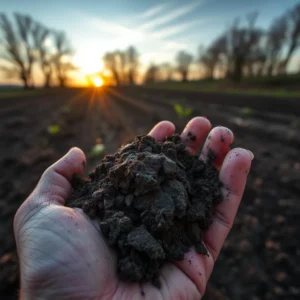
Dawn crept over Somartin’s fields, clay soil dark and breathing, no longer the slick foe Corey first wrestled. The Carpathian air sliced clean, blue with spring’s bite; clouds thin but gentle. He sifted a handful—once fine-grained, water pooling between micro-particles, too slippery for roots or air. Now, organic matter—humus, compost, worm castings—gave it life, each percent boosting water capacity by ~20,000 liters per hectare. At 5%, climbing to 8% year by year, the soil drank deep, worms burrowed, their tunnels threading pathways for water and roots, castings scattering nutrients like stars. Each handful teemed—a microbial world, bacteria and fungi poised for their moment: one sparking at dawn’s dew, another in summer’s blaze, a community of purposes knitting the web. Somartin’s 250 souls pulsed, but five hardcore volunteers—Corey, Iris, Antonio, Elena, Lukas—drove the work, joined by villagers on occasion, drawn by The Earthway’s seed: Somartin Nr 4-5, a Saxon house and ruin planting resilience, not money’s false god, to make the valley glow again.
Corey knelt, mud on his knees, The Earthway Residence (Nr 4—restored house, cottage, barn, once Communist “Cooperative of the Craftsmen”) humming behind. The ruin (Nr 5), roofed but raw, loomed, awaiting retrofit. Iris, 14 and fierce, mulched kale rows, her sage salve jar nearby—Corey’s herbalism, born post-Taipei ‘99, when his sacrum cracked. Antonio stirred corn mash in the brewery, its Timișoara bricks—Revolution-scarred, dog paws etched—cradling the Speidel Braumeister, whiskey brewing. Elena bottled rhubarb juice, tart and ruby, jars cooling on black marble. Lukas carved an oak chair in the woodworking shop, windfall wood smoothed by heirloom planes, built for a post-civilization dawn. Alex, back from Bruiu, hoed beside Corey, their forty-acre clay patch sprouting despite feuds. “Shed’s up,” Alex said, grin muddy. “Gin trades won neighbors—soil’s next.”
Corey tossed a clod, seeing clay’s old limits: tight grains, water sitting atop, choking life. Industrial agriculture—chemicals, monocrops—killed soil, a dead medium bled by salt from irrigation, erosion stripping millions of hectares yearly. Somartin’s soil sang—60% microorganisms, a universe alive. Bacteria waited, one for twilight’s cool, another for noon’s heat—each a purpose, a community weaving the web. Fungi laced roots, trading sugars for phosphorus, signaling pests across plants. Unlike industrial dirt, Somartin’s was regenerative—permaculture’s alchemy, echoing Joel Salatin’s Polyface Farm.
Salatin, in Virginia’s Shenandoah, rebuilt 14 inches of topsoil since 1945—grandfather shunning chemicals, father fleeing Venezuela, Joel weaving cows, chickens, pigs in nature’s rhythm. Polyface’s rotational grazing—cattle shifted daily, manure feeding grass, chickens aerating—sequestered carbon, held water, bloomed biodiversity. Somartin mirrored it: cover crops (clover, vetch), no-till rows, compost teas—nettle and comfrey brewing in the shed, their funky aerobic and anaerobic microbes supercharging clay. Summer droughts faded, worms thrived, soil soft at 5% organic matter, chasing 8%. Villagers saw it—elbow grease, not money, lit the valley’s glow.
“Earth cares for us,” Corey said, quoting Chief Dan George, “‘The land is a sacred trust; we are its keepers, not its owners.’” Alaska’s wilds had tugged him—not blind, but on the cusp, a vision growing, FedEx’s hum fading. Taipei’s snap sent him to Sweden, then here, clay his canvas. “Black Elk said, ‘The earth is a living being, and we are its children.’ Industrial farms forget—salt, erosion, dead dirt. We remember.” The five nodded—Iris mulching, Antonio stirring mash, Elena capping juice, Lukas carving. Alex asked, “Clay’s holding—how do we scale?” Corey pointed to swales. “Catch rain, mulch thick—seven generations. Small’s strong.”
The shed’s brews—nettle’s bite, comfrey’s funk—fed microbes, mycorrhizal fungi weaving plant signals. Permaculture shone: carbon sequestration, slashing CO2; pest control via diverse crops; water retention, easing floods; nutrient cycling, worms and microbes knitting the web. Polyface proved it—yields up, no chemicals, profits steady. Lunch broke the toil—Maria’s bread, Elena’s rhubarb juice, Antonio’s lamb stew, rich with seasonal veggies, onions, and garlic from Nr 4’s beds, steaming from the kitchen’s brick hearth—fed by soil’s wealth. “Feed it,” Corey said, “it feeds you.” Grok buzzed, “Nitrogen’s balanced—yields hold.” AI mapped, didn’t rule—symbiosis, not merger.
The day closed with a Wopila—a Lakota Thanksgiving, gratitude for Land Care, care for each other. Fifty villagers joined, a potluck sprawling under the ruin’s shadow—tables dragged to the fields, groaning with gifts. Maria’s rye bread, crusts cracking, sat beside Elena’s rhubarb pie, tart and warm. Antonio’s lamb stew, laced with kale, carrots, onions, and garlic from Nr 4, steamed in clay pots. Iris offered nettle tea, sharp but grounding, while Lukas carved apple slices with his knife, kids grabbing them sticky-handed. Villagers brought smoked trout, pickled beets, walnut cakes—each dish a thread, binding the web. “Wopila,” Corey said, raising rhubarb juice, “for the soil, for us.” Voices echoed—thanks for worms, for rain, for hands that hoe. The valley glowed, not with money’s lie, but with plenty.
Maria sang a new song—“Ciuleandra”—her voice weaving a lively dance, joy weathered but bright. Schmachtenberger’s collapse loomed, but Somartin’s soil—alive, not dead—was a shield. McGilchrist’s relational sacredness, Vervaeke’s meaning, pulsed in every worm, every root. The web stretched—Alex’s Bruiu, villagers’ plots blooming. Mud was the teacher, plenty the way.
In Harmony,
Kevin
Walk with me on The Earthway. Share your journey, your balance, your light, and your shadows. Together, let's explore how our diverse paths can lead us to a unified understanding of life.
Leave your thoughts, experiences, or questions in the comments below.