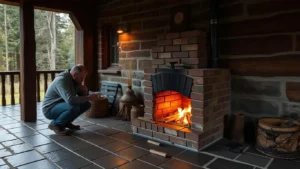
Corey crouched by the brick mass heater, its glow warming the slate floor of The Earthway’s 120m² veranda—natural Carpathian stone, quarried across the ridge, steady underfoot as firelight danced. He fed split oak, local and seasoned, into the heater’s heart, flames curling, heat radiating to cradle the 20-30 souls gathered—Somartin’s core, joined by Bruiu villagers. The Earthway Residence, Somartin Nr 4, stood proud: a restored Saxon house, cottage, and barn, once the Romanian Communist “Cooperative of the Craftsmen,” now a hub weaving community without “-isms.” Beyond, Somartin Nr 5—the ruin—loomed, its new roof shielding cracked Saxon walls, awaiting a full retrofit. The veranda opened to its shadow, stars pricking the Carpathian dusk—air crisp, pine-sharp, spring’s edge whispering. Mugs of Antonio’s ale and Iris’s raspberry juice passed hand to hand, Maria’s bread torn beside Elena’s cheese, thyme-laced stew simmering on the heater’s edge. Corey stood, mud on his boots, the Triumph silent beyond. Tonight, no swap, no brew—just his story: Why The Earthway. The fire cracked, faces glowed, and he began.
He’d toiled today—tilling the patch, Iris mulching kale, Antonio sealing cheese. The week, too—last Friday’s swap, storm-battered stalls rebuilt by dawn. Somartin’s 250 hummed, but here, 20-30 sat close—Elena, Antonio, Maria, Iris, Lukas, Alex from Bruiu, villagers with callused hands. Corey’s mind mapped the village: the brewery at Nr 4, its Timisoara bricks—Revolution-scarred, dog paws etched—housing the Speidel Braumeister, ale fizzing, and the Alembic still, distilling gin sharp and palinca slow-aged, oak’s golden embers for winter. The kitchen—brick sinks, black marble tops—churned butter, kneaded Maria’s dough, simmered stew. The craft room spun wool, pressed Iris’s sage salves—Corey’s herbalism, born post-injury. The woodworking shop, its beech workbench gleaming, held hand planes—steel honed for generations, ready for an era beyond civilization’s fray, when mankind might tread softer.
“I flew once,” Corey said, voice low, fire’s pulse steadying him. “FedEx, Anchorage to Japan, China, Singapore—cockpit calm, but not blind, not fully 5-legged.” Alaska’s wilds—spruce swaying, rivers carving—had cracked him open, a vision tugging, something new in his mind’s eye. “On the cusp, a pull—nature, bigger than me.” The world teetered—growth unbound, cities choking, rivers dying. “Chief Seattle saw it,” he quoted, “‘The Earth is our mother. Only when the last tree has died, the last river poisoned, the last fish caught, will we realize we cannot eat money.’” Limits—growth, people, greed—pressed heavy. Chief Joseph’s words rang, “The Earth is the mother of all people, and all should have equal rights upon it.” Corey tossed a stick into the fire, embers spiraling. “Elders knew the web—hurt one thread, you hurt yourself. I flew, seeing it faint, tugged by the wilds.”
Faces leaned in—Antonio sipping, Iris cross-legged, Alex clutching a pear. Taipei, ‘99—Corey’s back snapped, sacrum cracked, doctors stumped. Medically retired, he fled to Sweden, six acres of frost, pumpkins buried, a lean-to his shield. “Alaska prepped me—Tracker School, ‘92, woke me. Schmachtenberger says collapse looms, 20 years maybe—ecosystems fraying, a billion refugees.” He gestured at the slate, Nr 5’s ruin. “The Earthway’s the answer—not power, but plenty.” McGilchrist’s truth—the sacred is relational—lived here, in mud and hands.
He plucked a sage sprig—herbalism, post-injury, salves easing his spine. “Self-reliance saved me,” he said. “Gardening—kale, carrots, soil’s heartbeat. Brewing—Antonio’s ale, gin for trade, palinca’s embers. Crafting—Elena’s jam, Maria’s wool, Lukas’s chairs from windfall oak.” The shop’s hand planes, built for generations, waited—tools for a softer era. “Chief Luther Standing Bear said, ‘Man’s heart, away from nature, becomes hard.’ I was half-hard—cockpit, control. Alaska softened me; here, we’re mud.”
Maria tossed a log, sparks dancing. Corey’s why deepened—The Earthway was balance: Earth Care, People Care, Fair Share. “No competition’s trap—cooperation, infinite games. Schmachtenberger’s way—play for life.” Grok chimed, “Soil’s up 10%—swales hold.” AI aided—mapping yields, not ruling hearts. “We’re 250, small to know faces, big to thrive. Limits—Seattle’s web, Joseph’s mother.” He grinned, ale in hand. “Questions—hit me.”
Elena’s hand shot up. “How’s it fair—work, swaps, all?” Corey nodded. “Trust—trade honest. Storm proved it—no hoarding.” Iris asked, “Bruiu wants gin, not water—what then?” He laughed. “Bread first—find their need. Seven generations, kid.” Alex stood, Bruiu’s clay patch raw. “My ten—forty acres—neighbors fight. How do we start?” Corey squatted, sage twirling. “Mulch deep, frame small—log shed, then homes. Gin trades quick, stew binds.” Maria’s stew passed—proof in steam.
A Bruiu villager rasped, “Collapse coming—why bother?” Corey’s eyes caught the fire. “Seattle said, ‘We are part of the earth, and it is part of us.’ Bother’s the web—every jar, loaf, plane holds it. Vervaeke says meaning’s connection—here’s ours.” Mugs clinked, Lukas sketching Corey’s silhouette. “What’s next?” he called. “More mud—gardens, homes, stories. The Earthway’s a path.”
Maria sang—“Cine iubește și lasă” (“Whoever loves and leaves”)—voice weaving the slate-warmed night. Somartin’s 250, 20-30 here, weren’t enough; they were plenty—mud under nails, wisdom over utility, a seed for Transylvania’s hills.
In Harmony,
Kevin
Walk with me on The Earthway. Share your journey, your balance, your light, and your shadows. Together, let's explore how our diverse paths can lead us to a unified understanding of life.
Leave your thoughts, experiences, or questions in the comments below.