
Exploring Virtues in Catholic, Lakota, Zen, and Taoist Traditions
In my initial post, "The Beginning of a Spiritual Odyssey: Blending and Balancing," I shared how my Catholic upbringing and subsequent partial disillusionment led me on a quest for deeper spiritual understanding. My aim was never to harshly critique Organized Religion, though perhaps my words may have come across as such.
For several years, I've been captivated by the journey of Fr Johannes Schwarz, an Austrian Catholic priest (https://www.youtube.com/@donjojohannes) who has chosen a unique path as a part-time hermit in the Italian Alps. Living in a stone house he meticulously restored, Fr Johannes spends his days immersed in gardening and building, often captured in his YouTube videos working on stone walls, tending to his greenhouse, or maintaining his wood stove. The latter part of each video is dedicated to sharing his philosophical insights and their connection to Catholic doctrines. This year, in his first four episodes, Fr Johannes embarks on a profound exploration of the essence of religion and spirituality. He contrasts modern perceptions of spirituality with traditional religious practices, emphasizing that religion, as understood by the ancients, is fundamentally about guiding a good life through virtues, rather than merely following organized practices or doctrines. He critiques the modern spiritual movement for its perceived lack of depth and commitment to truth, advocating for a more rigorous engagement with religious questions.
Summarizing the first three videos, Fr Johannes delves into the virtues of Prudence, Justice, Temperance, and Fortitude. Prudence involves the application of reason to discern right action, crucial for navigating life's moral complexities. Justice extends beyond legal or societal norms, encompassing the moral obligation to give what is due, including to the Divine if one believes in a deity. Temperance is about moderation in the pursuit of sensory pleasures, ensuring balance between enjoyment and excess. Fortitude embodies the strength to pursue what is good despite hardships, reflecting resilience in moral conduct.
Fr Johannes views religion as a virtue, an extension of justice where one acknowledges and responds to the divine through acts of worship. These acts, both internal (prayer, devotion) and external (rituals, sacrifices), are not merely symbolic but meaningful attempts to reciprocate the gifts received from a higher power. His discussions aim to bridge diverse spiritual traditions, illustrating how they all guide individuals toward a virtuous life. He challenges the notion that spirituality can be separated from structured religion without losing depth or commitment to living ethically, critiquing not spirituality itself but its modern form for sometimes lacking in the pursuit of truth and moral rigor.
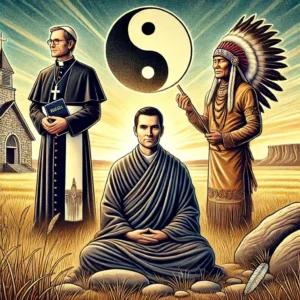
This leads me to hypothesize that Native American Spirituality, particularly my experience with the Lakota, as well as Zen Buddhism and Taoism, share similar goals with Catholicism. Let's explore this further, starting with the Lakota and their story of the White Buffalo Calf Woman, which is central to their spiritual practices and around 2,000 years old.

During a time of great famine, two Lakota scouts were sent out by their chief to find food. While hunting in the sacred Black Hills of South Dakota, they encountered a mysterious figure in the distance. As the figure approached, it transformed from what appeared to be a white buffalo calf into a beautiful woman dressed in white buckskin. One scout approached with lustful intentions, and after a warning from the woman, a black cloud enveloped him, leaving behind only his skeleton, teaching a lesson about respect and purity of thought. The other scout, who showed respect, was told to return to his people and prepare for her arrival by setting up a large tipi.
Upon her arrival, the White Buffalo Calf Woman carried a bundle containing the sacred pipe (chanunpa). She stayed for four days, teaching them the "Seven Sacred Rites" to live in harmony with Wakan Tanka (the Great Spirit) and each other. These rites include the Sweat Lodge Ceremony, the Naming Ceremony, the Healing Ceremony, the Adoption Ceremony, the Marriage Ceremony, the Vision Quest, and the Sun Dance. Before leaving, she gave the people the sacred pipe, symbolizing peace, prayer, and connection between the people and the Divine. She promised to return one day to restore harmony and spiritual balance to the world. As she departed, she transformed four times, each time into a different colored buffalo (black, red, yellow, and finally white), symbolizing the four directions and the unity of all races.
The Lakota path, often referred to as the "Good Red Road," emphasizes living in harmony with nature and community, focusing on integrity, respect, and courage. It aligns with the cardinal virtues by promoting a life of moral rectitude and communal justice.
The Seven Sacred Rites of the Lakota bear striking parallels to the Catholic virtues in fostering personal and communal harmony:
1. The Sweat Lodge Ceremony: This involves purification through sweat, prayer, and reflection, teaching individuals to make wise decisions by cleansing the mind and spirit. It encourages self-examination and communal bonding, aligning with the prudent use of one's faculties for personal and collective well-being, thereby teaching Prudence. By enduring the conditions of the lodge, participants learn to control their physical desires and focus on spiritual goals, embodying temperance in the face of discomfort, teaching us Temperance.
2. The Naming Ceremony: Naming is about recognizing and affirming one's identity within the community, which is a form of giving what is due to each person. It ensures that every individual is acknowledged and valued, promoting justice by affirming equality and respect for all, teaching us Justice.
3. The Healing Ceremony: This ceremony aims to restore balance and health, not just to the individual but to the community, reflecting justice in healing relationships and mending social fabrics, showing us Justice. Healing often requires patience and moderation, teaching participants to manage their emotions and physical responses to illness or conflict, and imparts Temperance.
4. The Adoption Ceremony: By adopting someone into the tribe or family, this ceremony acknowledges the rights and responsibilities of kinship, extending the circle of care and support, which is a just act of community building, teaching Justice. It involves careful consideration of who is brought into the community, ensuring the decision benefits all parties and fosters harmony, showing and teaching Prudence.
5. The Marriage Ceremony: Marriage in this context is about recognizing the partnership and mutual responsibilities of the couple, ensuring each receives what is due in terms of respect, support, and love, showing us Justice. It promotes moderation in personal desires and a commitment to shared life, fostering self-control and mutual respect, which teaches us Temperance.
6. The Vision Quest: This rite of passage requires endurance, fasting, and solitude, embodying the virtue of fortitude through facing physical and spiritual challenges to gain wisdom or guidance. The seeker is prompted to reflect deeply on life's purpose, promoting prudent life choices based on visions or insights gained, which teaches us Prudence.
7. The Sun Dance: One of the most physically and spiritually demanding ceremonies, it teaches endurance, sacrifice, and renewal, all aspects of fortitude. It's a communal event where everyone's participation is aimed at communal healing and thanksgiving, ensuring all contribute to and benefit from the collective spirit, thereby teaching us Justice.
These ceremonies not only serve spiritual purposes but also act as moral compasses, guiding the Lakota people in living lives of balance, respect, and communal harmony, much like the Catholic virtues aim to guide personal and communal ethics.

Expanding on how Zen Buddhism, Taoism, and their practices relate to both the Catholic virtues and the virtues implicitly embedded in Lakota ceremonies:
Zen Buddhism and Taoism:
In Zen Buddhism, while "zazen" or sitting meditation is often highlighted, especially in some modern Japanese practices, it is one of four key types of meditation that together foster a comprehensive approach to spiritual growth. Alongside zazen, there are three other essential forms: kinhin (walking meditation), which integrates movement with mindfulness; sanzen (personal interview with a teacher), which provides direct guidance and personal reflection; and sozan (work meditation), where everyday tasks become meditative practice. Each type contributes uniquely to the cultivation of intuitive wisdom, akin to the Catholic virtue of prudence.
Zazen, the practice of sitting meditation, is central to achieving insight or satori, and it clears the mind to enhance intuitive understanding of life. This aligns closely with the Catholic concept of prudence, where one uses reason to discern right action. Zen's emphasis on direct experience and mindfulness encourages a thoughtful, reflective way of living, much like the prudent person who reflects before acting.
The other three types of meditation in Zen further enrich this intuitive wisdom. Kinhin, or walking meditation, allows practitioners to maintain mindfulness while in motion, fostering an awareness that can be applied to daily life. Sanzen, the personal interview with a teacher, offers a direct channel for receiving guidance and reflecting on one's practice, enhancing personal insight and decision-making skills. Sozan, or work meditation, transforms mundane tasks into opportunities for mindfulness, teaching practitioners to act in harmony with their surroundings, much like the Taoist concept of "wu wei" or effortless action.
This intuitive wisdom, nurtured through all four types of Zen meditation, parallels the prudence found in Catholic teachings. It involves knowing when to act and when to refrain, based on a deep understanding of the natural flow of life, similar to the Taoist principle of acting in harmony with the Tao. By integrating zazen, kinhin, sanzen, and sozan, Zen practitioners develop a holistic approach to living wisely and prudently.
- Temperance (Non-Attachment): Zen Buddhism teaches non-attachment, encouraging practitioners to release desires and attachments to material things, emotions, or outcomes. This practice can be seen as a form of temperance, where one moderates personal desires for a more balanced life, similar to how Catholics are encouraged to control their passions. Taoism promotes living simply and in harmony with nature, encouraging non-attachment to worldly possessions or status, embodying temperance by not overindulging in what is transient or unnecessary.
- Fortitude (Bravery in Impermanence): Zen Buddhism requires facing the reality of impermanence (all things change) with equanimity, which demands fortitude. The acceptance of life's transient nature builds resilience, much like the Catholic virtue of fortitude, where one persists in doing good despite adversity. Taoism encourages embracing the natural cycles of life and death with courage, reflecting fortitude. The Taoist virtue of maintaining balance through life's ups and downs mirrors the Catholic encouragement to endure hardships with moral steadfastness.
- Justice (Doing What is Just and Right): While neither Zen Buddhism nor Taoism explicitly lists justice as a virtue, their emphasis on living in harmony with all beings, nature, and the self inherently promotes a form of justice. This is about recognizing the interconnectedness of all things, akin to the Catholic understanding of justice where one gives to each their due, including respect for the environment and all creatures.
Relation to Catholic and Lakota Virtues:
- Catholic Virtues: Prudence, Justice, Temperance, and Fortitude are cardinal virtues within Catholicism, with each ceremony and practice aimed at nurturing these qualities. The Catholic approach is more doctrinal, with explicit teachings on these virtues, but the end goal is similar: to live a life aligned with divine will and moral excellence. Acts of worship in Catholicism are not just rituals but expressions of love, gratitude, and obedience to God, akin to how Zen and Taoist practices are ways to honor and align with the Tao or the natural order, and Lakota ceremonies give thanks to Wakan Tanka.
- Lakota "Virtues": The Lakota ceremonies, like those in Zen and Taoism, don't explicitly name virtues but embody them through practice. The Sweat Lodge for purification (temperance, prudence), the Vision Quest for personal insight (prudence, fortitude), and the communal nature of the Sun Dance (justice through collective celebration and sacrifice) all echo the Catholic virtues in practice if not in name. Both the Lakota and Eastern philosophies emphasize living in harmony with the natural world and community, which can be seen as an expression of justice and prudence, ensuring all parts of life are respected and maintained in balance.
In essence, while the expressions might differ, Zen Buddhism, Taoism, Catholicism, and Lakota spirituality all share a common pursuit of living virtuously through practices that cultivate wisdom, balance, courage, and justice, each tailored to the cultural and spiritual context of their tradition.
In this exploration, I have hypothesized that Native American Spirituality, particularly my experience with the Lakota, as well as Zen Buddhism and Taoism, share similar goals with Catholicism in guiding individuals toward a virtuous life. Through the lens of Fr Johannes Schwarz's journey and his emphasis on the Catholic virtues of Prudence, Justice, Temperance, and Fortitude, we can see a clear parallel with the spiritual practices of other traditions.
The Lakota's Seven Sacred Rites, as exemplified by the story of the White Buffalo Calf Woman, serve as a moral compass, guiding the people to live in harmony with Wakan Tanka and each other. These rites embody the virtues of Prudence through self-reflection and wise decision-making, Justice through recognizing and affirming the rights and responsibilities of community members, Temperance through moderation and control of desires, and Fortitude through enduring physical and spiritual challenges for the greater good.
Similarly, Zen Buddhism and Taoism cultivate these virtues through their meditative practices. Zazen, kinhin, sanzen, and sozan in Zen Buddhism foster intuitive wisdom, akin to Prudence, while non-attachment and the acceptance of impermanence reflect Temperance and Fortitude. Taoism's emphasis on living in harmony with the Tao and the natural world promotes a form of Justice that recognizes the interconnectedness of all things.
While the expressions of these virtues may differ across cultural and spiritual contexts, the underlying pursuit of living a virtuous life remains a universal quest. The Catholic virtues, as explored by Fr Johannes, find echoes in the practices of the Lakota, Zen Buddhists, and Taoists, demonstrating that despite the diversity of religious traditions, there is a shared goal of guiding individuals toward wisdom, balance, courage, and justice. This hypothesis is supported by the striking parallels between the virtues embodied in these diverse spiritual practices, suggesting that the quest for virtue is indeed a universal human endeavor, transcending the boundaries of specific religious doctrines or practices.
____________________________________________________________________________
In Harmony,
Kevin
Walk with me on The Earthway. Share your journey, your balance, your light, and your shadows. Together, let's explore how our diverse paths can lead us to a unified understanding of life. This article hypothesizes that despite their surface differences, the spiritual practices of Catholicism, Lakota traditions, Zen Buddhism, and Taoism all converge on a common pursuit of virtues like Prudence, Justice, Temperance, and Fortitude. I believe there's a profound connection in how these traditions guide us toward living a virtuous life, each in its unique way.
What Do YOU Think?
- How do your personal experiences with spirituality or religion resonate with or challenge this hypothesis?
- Do you see similar virtues being nurtured in your spiritual practice or community?
- Have you encountered instances where different spiritual paths seemed to lead to the same moral or ethical conclusions?
Leave your thoughts, experiences, or questions in the comments below. Your insights are invaluable in broadening our collective understanding of the universal quest for virtue.